An infinitely long wire has uniform linear charge density  . The net flux through a Gaussian cube of side length
  , if the wire passes through any two corners of the cube, that are maximally displaced from each other, would be
  , where x is:
[Neglect any edge effects and use 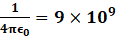 SI units]


Text Solution
Verified by ExpertsD
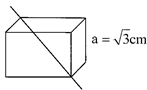
To find the net flux through a Gaussian cube when an infinitely long wire with a uniform linear charge density  passes through the cube's diagonal corners, we use
Gauss's Law. The relevant expression is:

Here,  is the charge enclosed by the Gaussian surface, and
  is the permittivity of free space.
Given:
The wire passes through two opposite corners of the cube.
The side length of the cube,

The length of the wire inside the cube is equal to its diagonal, which is  .
.
Thus, the charge enclosed  is:
is:
 (length of wire inside the cube)
Substitute the given values:
The length of the wire inside the cube is equal to its diagonal, which is  .
.
Thus, the charge enclosed  is:
is:
 (length of wire inside the cube)
Substitute the given values:

Calculating:

Now apply Gauss's Law for net flux:
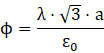
Substitute 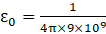 :
:


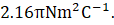
Thus, the net flux through the Gaussian cube is
Prepare Smarter with CGP Edu
Get practice questions, solutions, and test series in one place.
Write a Review
Share your experience with this question and solution.
Commentary
Send your comment, doubt, correction, or feedback to admin.
Similar Questions
Explore conceptually related problems